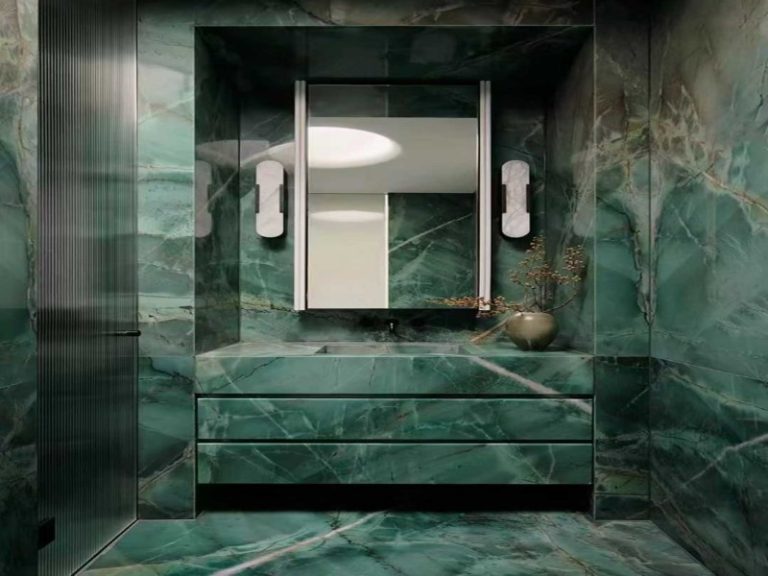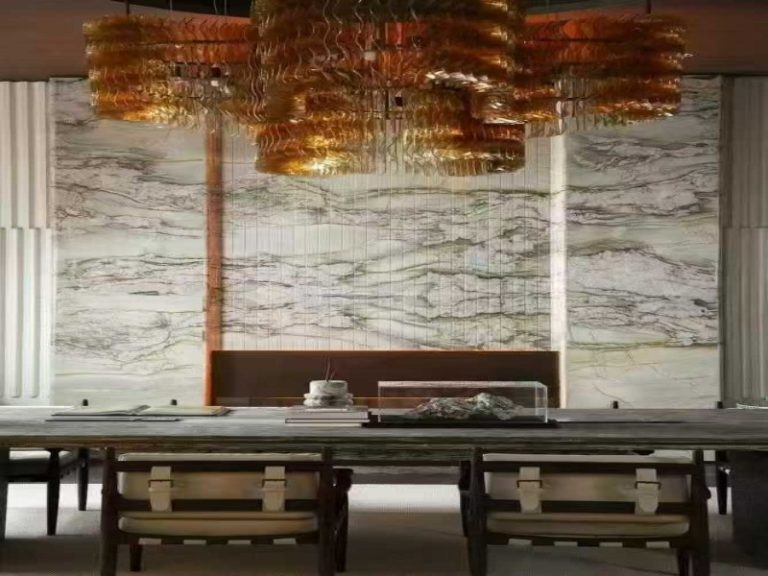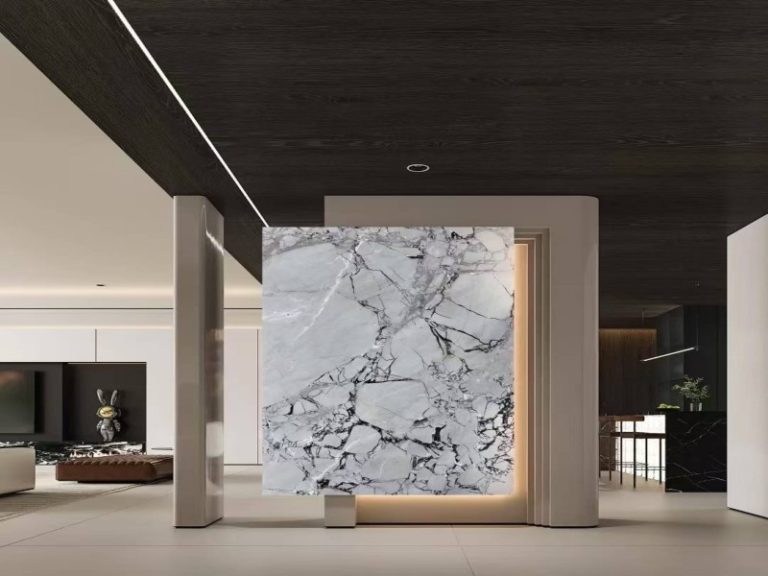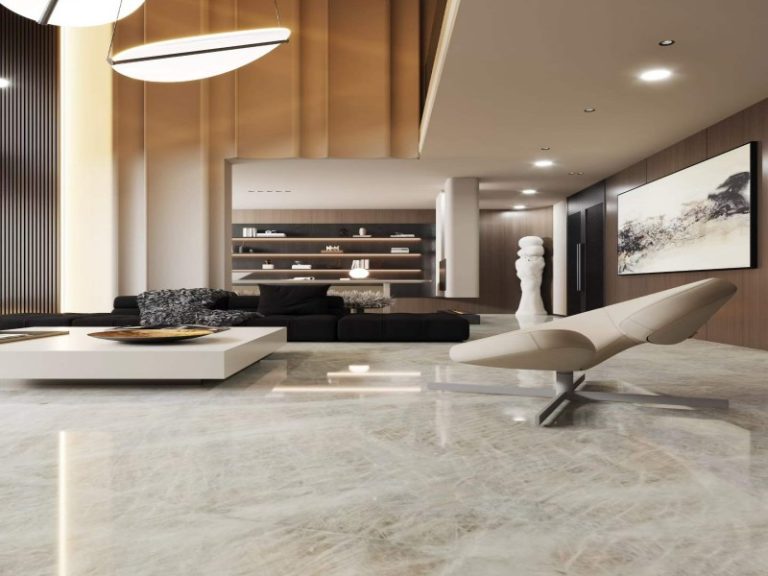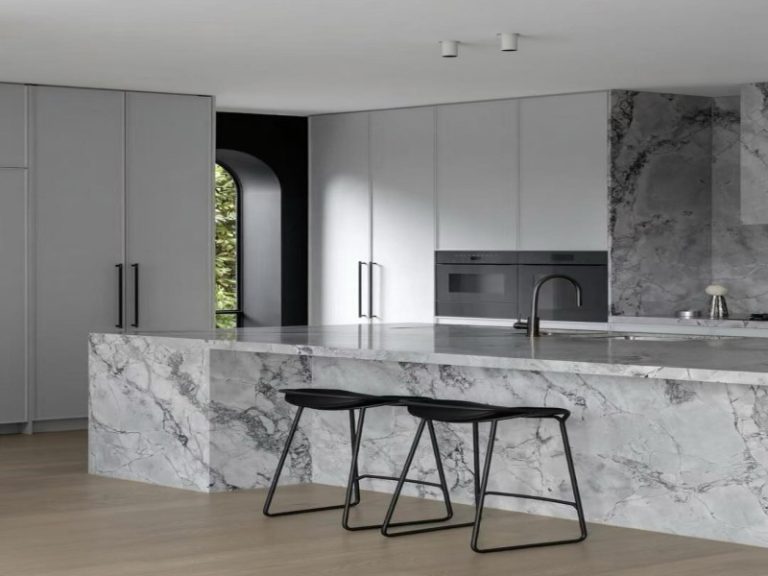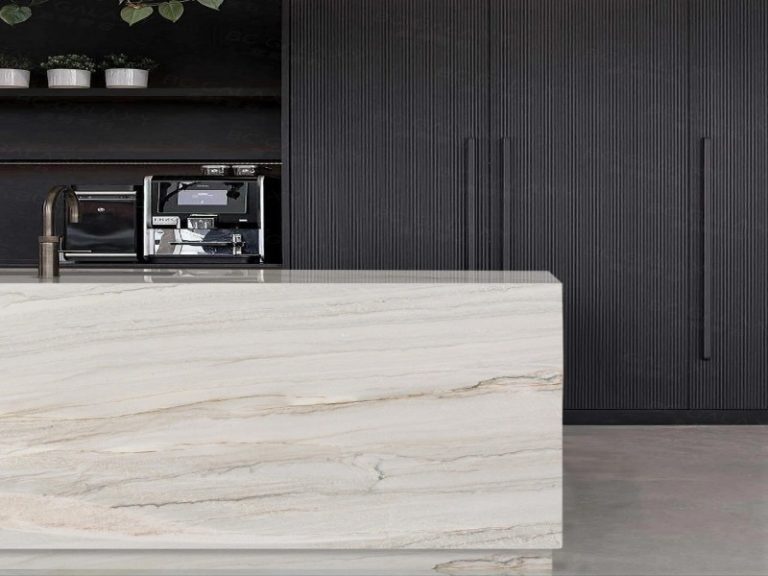
Arabescato Corchia Marble is a premium Italian white marble distinguished by its bright white background and expressive grey to charcoal veining. Quarried in the Carrara marble district of Tuscany, it combines the classical elegance of Italian white marble with a stronger, more dramatic vein structure. Selected Arabescato Corchia slabs are particularly suitable for feature walls, bathrooms, flooring, countertops, reception areas and high-end residential or hospitality projects.
What Is Arabescato Corchia Marble?
Arabescato Corchia Marble, commonly searched as Arabescato Corchia or Corchia Marble, is a natural marble from the Apuan Alps in Tuscany, Italy. It belongs to the prestigious family of white marbles associated with the Carrara quarrying region.
The material is recognized for a white to slightly cool-white background crossed by irregular grey, smoky grey and occasionally darker graphite veins. Unlike marbles with long, widely spaced linear veins, Arabescato Corchia often develops a more interconnected and expressive pattern across the slab.
This movement creates the characteristic “arabesque” appearance associated with premium Arabescato marble and makes every slab visually unique.
Alternative Names & Related Market Terms
Depending on the supplier, quarry selection and market, buyers may encounter related search terms including:
- Arabescato Corchia
- Corchia Marble
- Arabescato Marble
- Italian Arabescato Marble
- Arabescato White Marble
- White Arabescato Marble
- Arabescato Bianco
- Arabescato Corchia Extra
Arabescato Corchia Extra normally refers to a higher or specially selected commercial grade rather than a completely different geological material. Selection criteria may include background whiteness, vein distribution, slab integrity and overall aesthetic quality.
Calacatta Corchia and Calacatta Corchia Marble are also encountered in the international stone market. However, these names should not automatically be treated as exact synonyms for every Arabescato Corchia selection. Commercial naming can vary between quarries and suppliers, so slab photos and block selection should always be confirmed for project specifications.
Color & Veining
Arabescato Corchia is primarily characterized by a white to cool-white marble background with medium to strong grey veining. Depending on the block, the veins may appear soft and cloudy or develop into more dramatic charcoal-grey networks.
Typical visual characteristics include:
- White to cool-white base color
- Grey and smoky-grey veining
- Occasional darker graphite vein sections
- Irregular arabesque-style movement
- Medium to high natural variation
- Strong visual continuity when consecutive slabs are selected
Because the pattern can vary significantly between blocks, the actual slab selection is particularly important for large feature walls, bookmatched installations and projects requiring consistent visual flow.
Material Specifications & Available Options
| Material | Natural Marble |
| Commercial Name | Arabescato Corchia Marble |
| Petrographic Classification | Marble / Monogenic Marble Breccia |
| Origin | Monte Corchia, Apuan Alps, Tuscany, Italy |
| Primary Color | Milky White to Ivory White |
| Secondary Colors | Grey, Blue-Grey, Grey-Green, Yellowish Brown |
| Pattern & Veining | Distinctive arabesque movement with irregular grey veining and characteristic ovulated / brecciated formations |
| Natural Variation | Medium to High |
| Apparent Density | 2,710 kg/m³ — EN 1936 |
| Water Absorption | 0.17% — EN 13755 |
| Open Porosity | 0.40% — EN 1936 |
| Flexural Strength | 13.9 MPa — EN 12372, dry condition |
| Flexural Strength After Freeze-Thaw | 13.5 MPa — after 48 frost cycles, EN 12371 / EN 12372 |
| Compressive Strength | 86.8 MPa — EN 1926 |
| Slip Resistance – Honed Finish | 63 SRV dry / 33 SRV wet — EN 14231 |
| Common Slab Thickness | 18 mm, 20 mm, 30 mm; custom thickness subject to availability and project requirements |
| Available Formats | Slabs, cut-to-size panels, tiles, countertops, vanity tops, flooring, wall cladding, stairs and custom fabricated pieces |
| Common Finishes | Polished, Honed and project-specific finishes |
Recommended Applications & Design Solutions
From a material-selection perspective, Arabescato Corchia Marble works best where the natural veining is allowed to become part of the architectural composition rather than being treated simply as a neutral white surface.
Feature Walls & Large Wall Panels
Large-format Arabescato Corchia slabs are particularly effective for lobby walls, reception areas, fireplace surrounds and residential feature walls. The contrast between the white background and darker veins remains visible from a distance, giving large spaces stronger architectural depth.
Luxury Bathrooms
The material works well for bathroom walls, vanity tops, shower surrounds and custom stone details. Consecutive slabs can be arranged to maintain vein continuity across larger wall elevations.
Kitchen Countertops & Islands
Arabescato Corchia can create highly distinctive kitchen islands and countertops, particularly in luxury residential projects. As a calcitic marble, however, it can react with acidic substances and should be selected with an understanding of natural marble maintenance requirements.
Hotel & Commercial Interiors
For hotels, luxury retail spaces and commercial reception areas, the strong veining gives Arabescato Corchia greater visual impact than many relatively uniform white marbles. It can be used for reception desks, wall cladding, lift surrounds, decorative flooring and custom architectural elements.
Flooring
Interior flooring is possible, especially in residential and controlled commercial environments. Honed finishes can be considered where a softer appearance is preferred. For high-traffic areas, the expected wear level and maintenance program should be evaluated during material specification.
Bookmatching & Large-Format Slab Design
One of the strongest applications for Arabescato Corchia is bookmatched or vein-matched wall installation. When consecutive slabs are available, the grey veining can be arranged into symmetrical or continuous compositions.
For large projects, FAVAN STONE recommends confirming the slab sequence before cutting. This allows the designer, contractor and fabricator to coordinate the vein direction with elevations and cutting drawings before production begins.
Installation & Maintenance
Arabescato Corchia should be installed using methods appropriate for premium white marble. A high-quality white setting material is generally recommended to reduce the risk of discoloration or shadowing through the stone.
- Use installation products suitable for natural white marble.
- Seal the stone where required according to the application.
- Use pH-neutral stone cleaners for routine maintenance.
- Avoid acidic cleaners and aggressive chemicals.
- Clean wine, citrus juice, vinegar and similar acidic substances promptly.
- Protect countertops from direct impact and prolonged exposure to staining substances.
- Confirm substrate, fixing method and stone thickness for large-format wall panels.
Natural Variation & Slab Selection Guidance
Natural variation is an important characteristic of Arabescato Corchia Marble. Background color, vein density, vein direction and the proportion of darker grey areas can change significantly from one block to another.
Some selections have a cleaner white background with relatively controlled grey veins, while others show much stronger movement and darker interconnected patterns.
For this reason, FAVAN STONE recommends selecting the actual slabs rather than approving the material only from a small sample.
For larger architectural projects, we normally evaluate:
- Background whiteness
- Grey vein intensity
- Overall vein direction
- Slab-to-slab continuity
- Natural fissures and structural characteristics
- Usable slab area
- Required cutting dimensions
- Bookmatch or vein-match requirements
For projects requiring multiple slabs, selecting consecutive slabs from the same block can significantly improve visual consistency.
Arabescato Corchia Extra vs Standard Selection
The term Arabescato Corchia Extra is generally used commercially for specially selected slabs or blocks. “Extra” should not be interpreted as a universal technical grade because selection standards can differ between quarry operators and suppliers.
In practice, premium selections are often evaluated according to background cleanliness, desirable vein distribution, structural integrity and the overall aesthetic balance of the slab.
For specification projects, actual slab approval remains more reliable than relying only on commercial grade terminology.
Design & Pairing Ideas
Arabescato Corchia works particularly well with materials that allow its grey veining to remain visually dominant.
- Warm natural timber: softens the cool white and grey palette.
- Dark timber: creates a stronger luxury contrast.
- Brushed brass or bronze: introduces warmth into bathrooms and hospitality interiors.
- Black metal: reinforces the darker graphite veins.
- Neutral beige surfaces: create a softer contemporary interior palette.
- White cabinetry: allows the marble veining to become the principal visual feature.
Frequently Asked Questions
1. What is Arabescato Corchia Marble?
Arabescato Corchia Marble is a premium Italian natural marble characterized by a white background and expressive grey to charcoal veining.
2. Where does Arabescato Corchia come from?
It originates from the Apuan Alps marble-producing region of Tuscany, Italy.
3. Is Arabescato Corchia the same as Arabescato Marble?
Arabescato is a broader commercial family of Italian white marbles. Arabescato Corchia refers more specifically to material associated with the Corchia quarrying area and its characteristic selections.
4. Is Arabescato Corchia the same as Calacatta Corchia?
Not necessarily. The names can be closely associated in the stone trade, but suppliers and quarry selections may distinguish between them. Actual slab appearance should be confirmed before specification.
5. What is Arabescato Corchia Extra?
Arabescato Corchia Extra generally refers to a specially selected premium commercial grade with desirable background color, veining and overall slab quality.
6. What color is Arabescato Corchia Marble?
It normally has a white to cool-white background with grey, smoky-grey and sometimes darker graphite veining.
7. Is Arabescato Corchia suitable for countertops?
Yes. It is widely used for luxury countertops and islands, although users should understand the etching and maintenance characteristics of natural marble.
8. Can Arabescato Corchia be used for kitchen islands?
Yes. Its large-scale veining makes it particularly suitable for statement kitchen islands where the slab pattern can be fully displayed.
9. Is Arabescato Corchia suitable for bathrooms?
Yes. It is suitable for vanity tops, bathroom walls, shower surrounds and other luxury interior applications when properly installed and maintained.
10. Can Arabescato Corchia be bookmatched?
Yes. Consecutive slabs can often be bookmatched or vein-matched to create dramatic feature walls and large architectural compositions.
11. Is Arabescato Corchia suitable for flooring?
Yes, particularly for interior residential and selected commercial applications. Finish, traffic level and maintenance requirements should be considered.
12. Does Arabescato Corchia need sealing?
Sealing is generally recommended where additional stain resistance is required, particularly for countertops, bathrooms and other frequently used surfaces.
13. Does Arabescato Corchia etch?
Yes. Like other calcitic marbles, it can react with acidic substances such as lemon juice, vinegar and some household cleaners.
14. What finishes are available?
Polished and honed are the most common finishes. Other finishes can be evaluated according to project requirements and slab characteristics.
15. What slab thicknesses are available?
Common thicknesses include approximately 18 mm, 20 mm and 30 mm, subject to current block and slab availability.
16. Does every Arabescato Corchia slab look the same?
No. Vein density, background tone and movement vary naturally between blocks and slabs, making slab selection particularly important.
17. How should Arabescato Corchia slabs be selected for a large project?
For large projects, slabs should be evaluated together for background consistency, vein direction, usable area and the required cutting layout. Consecutive slabs are preferable where visual continuity is important.
18. Can Arabescato Corchia be supplied as cut-to-size pieces?
Yes. In addition to slabs, it can be fabricated into cut-to-size wall panels, flooring, countertops, vanity tops, stairs and other custom architectural components.
Current Arabescato Corchia Marble Slab Selection
Arabescato Corchia varies considerably between blocks. Current slab selections may range from cleaner white backgrounds with controlled grey veining to highly expressive slabs with stronger charcoal movement. For projects requiring multiple slabs, FAVAN STONE can review current slab availability according to required dimensions, quantity, vein direction and visual consistency.
Expert Commentary & Analysis
Arabescato Corchia should be selected primarily according to the architectural effect required by the project. For large feature walls and statement islands, stronger vein movement can create excellent visual impact. For bathrooms, flooring or projects involving many cut-to-size pieces, a more balanced selection may provide better overall continuity and material utilization.
The highest-priced slab is therefore not automatically the best choice for every project. Slab dimensions, cutting yield, vein position and continuity should be evaluated together before final material approval.
Project & Material Selection Notes
For commercial and high-end residential projects, FAVAN STONE recommends combining slab selection with the approved cutting drawings. This makes it possible to allocate important vein sections to feature areas, control slab-to-slab transitions and improve overall material utilization.
For bookmatched walls, large islands or continuous wall elevations, the required finished dimensions should be reviewed against the available slab sizes before cutting begins. Current slab photos, dimensions and selection details can then be used for final material approval and production planning.