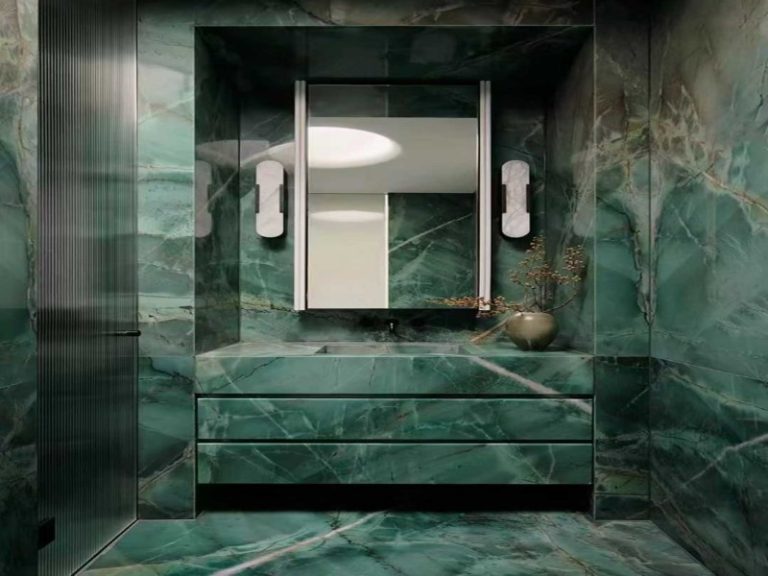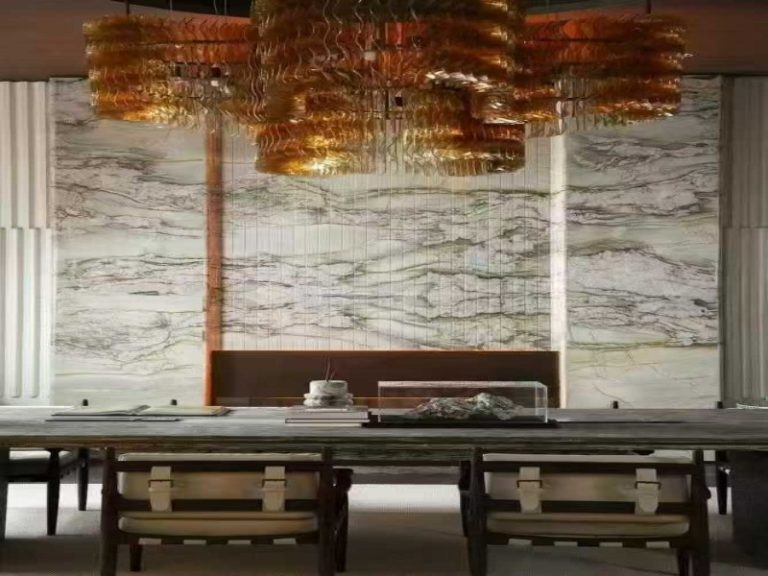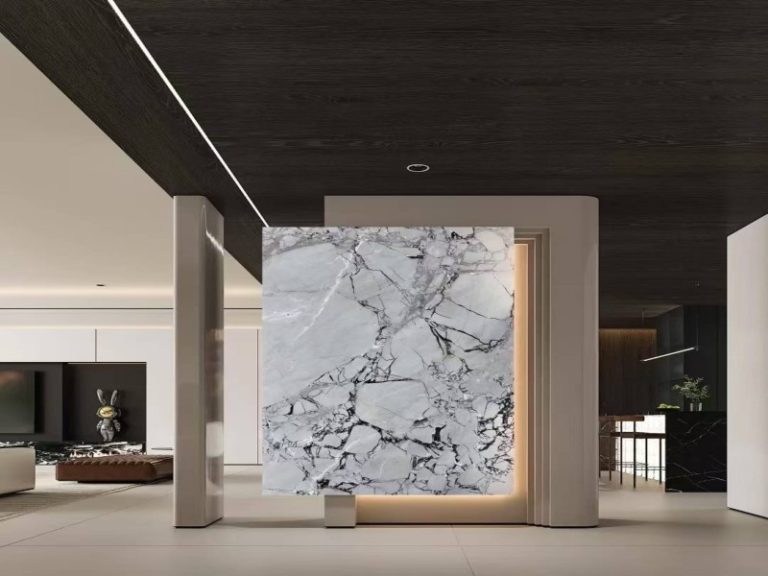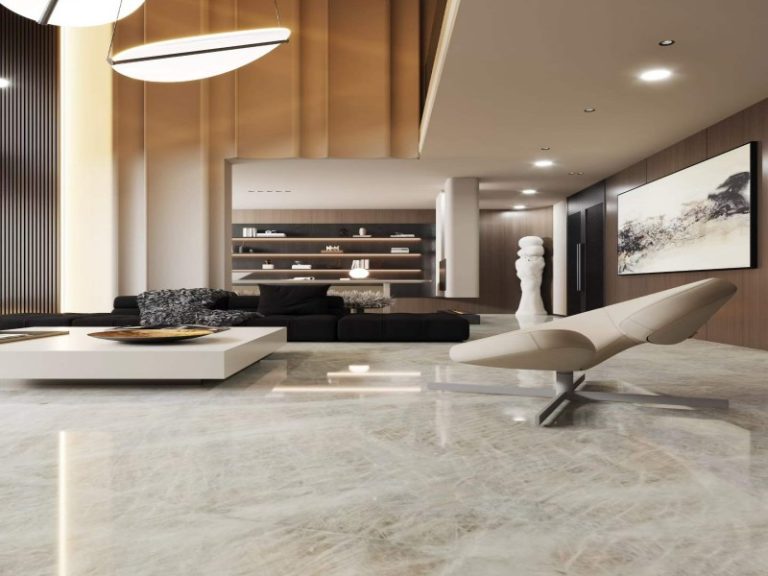
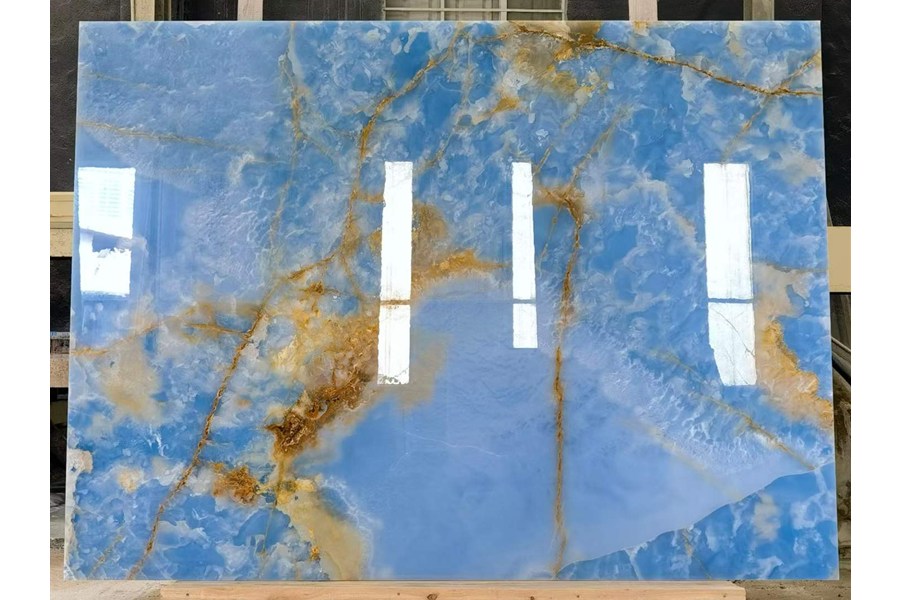
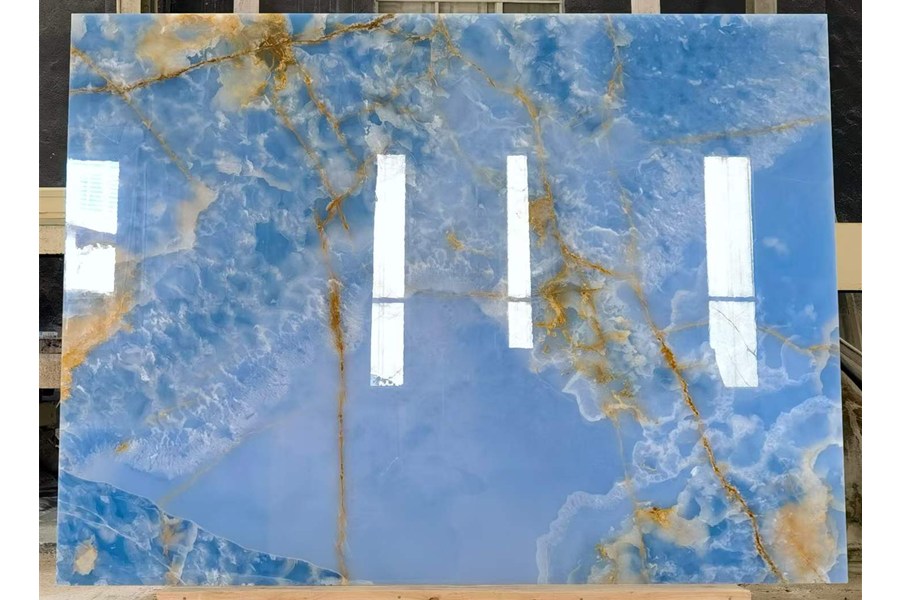
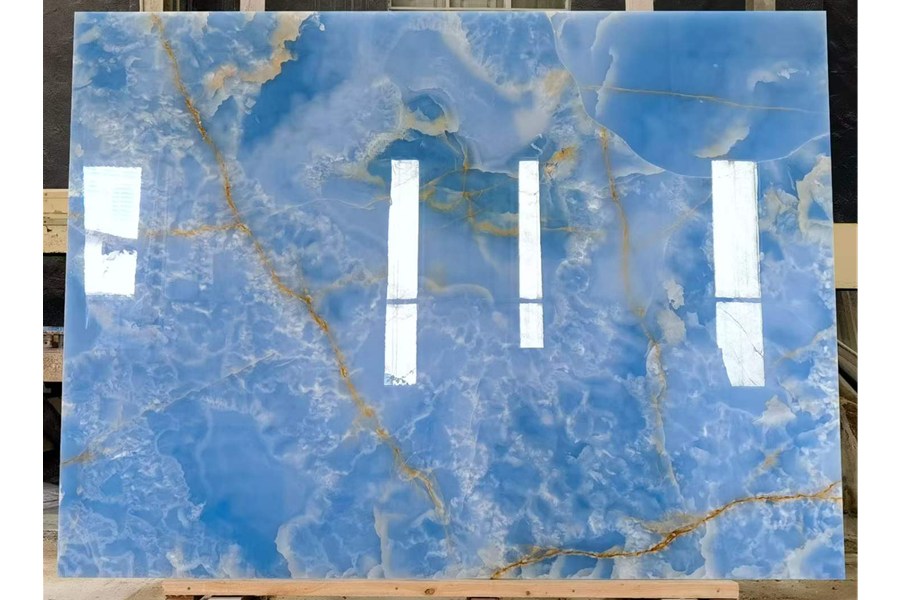
Blue Onyx is a translucent natural decorative stone distinguished by its soft sky-blue to icy-blue color, milky white crystalline movement and warm golden, amber and occasional rust-toned mineral accents. When illuminated from behind, its translucent structure reveals additional depth, cloud-like patterns and natural crystalline details that are less visible under normal lighting.
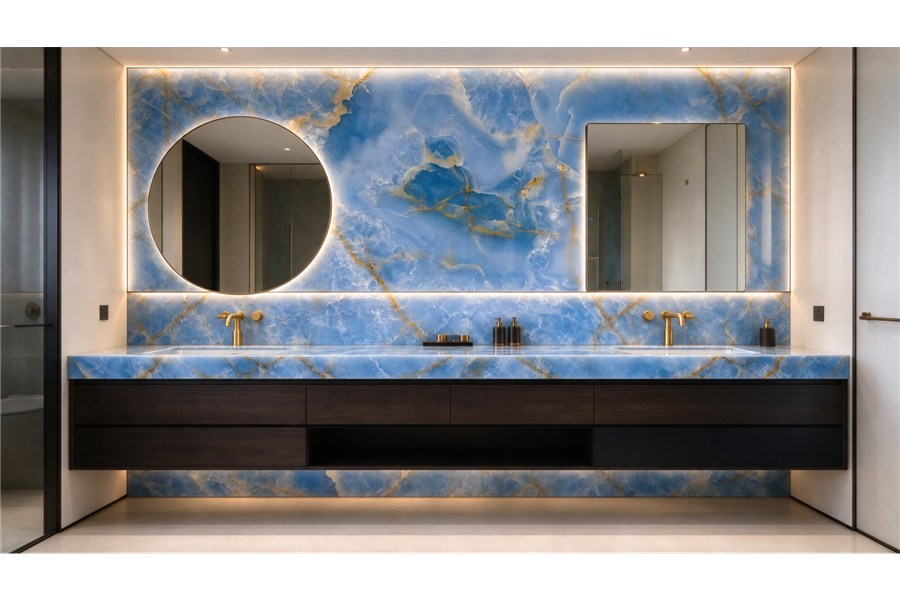
Available as Blue Onyx slabs and custom-fabricated panels, this material is particularly suitable for backlit feature walls, hotel reception areas, luxury bars, statement counters, bathroom features and other high-end interior applications where the stone itself becomes a focal design element.
What Is Blue Onyx?
Blue Onyx is a natural translucent decorative stone used primarily for luxury interior architecture. In the architectural stone trade, materials of this type are commonly marketed as natural onyx or onyx marble because of their translucent crystalline structure and distinctive layered mineral patterns.
Unlike conventional marble or quartzite, the visual value of Blue Onyx comes largely from its combination of color, translucency and internal mineral movement. The stone can display soft blue, icy blue and pale aqua areas mixed with milky white crystalline clouds, while golden, honey, amber and rust-toned minerals create warmer contrast across the slab.
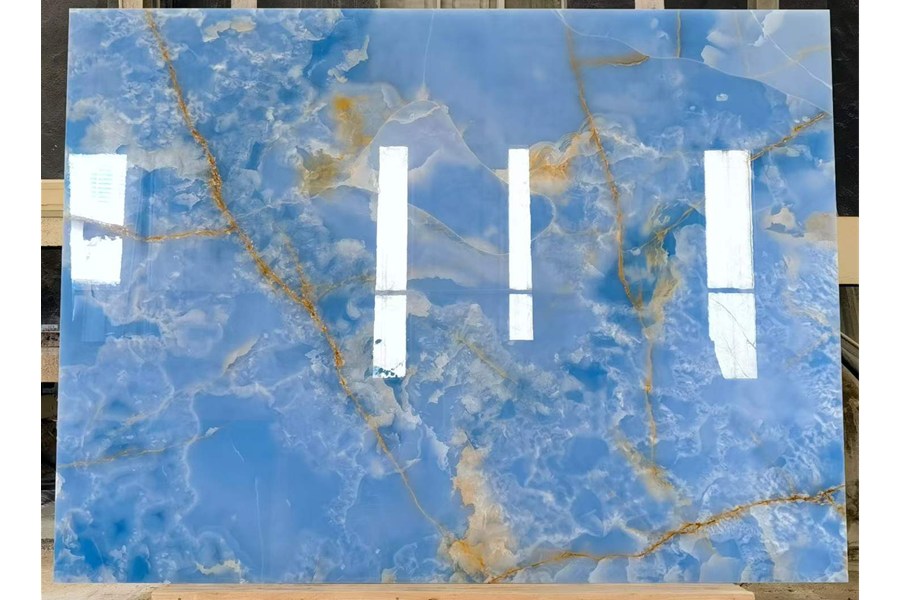
Because these colors and crystalline formations developed naturally, no two Blue Onyx slabs are identical. Some selections are predominantly soft blue and white, while others contain stronger golden mineral areas or more dramatic internal patterning.
Commercial Names & Search Terminology
Blue Onyx is the primary international commercial name used for this category of natural decorative stone. Buyers may also encounter search terminology such as Onyx Blue or Blue Onyx Marble when sourcing architectural slabs and interior materials.
Names such as Golden Blue Onyx, Aqua Blue Onyx, Sky Blue Onyx and Blue Crystal Onyx are also used in the international stone market, but they may refer to different varieties or selections. They should therefore not automatically be considered identical materials without comparing the actual slabs.
Color & Natural Appearance
The dominant color of Blue Onyx ranges from soft sky blue and powder blue to icy blue and pale aqua. These cool tones are interwoven with translucent white and milky crystalline formations that can create a cloud-like or almost watercolor appearance.
Warm mineral accents are another important feature. Depending on the block, the stone may contain golden yellow, honey, amber, beige and rust-toned areas. These warmer colors create strong visual contrast against the blue background and can become especially expressive when the slab is illuminated.
The pattern is generally non-uniform and organic rather than strictly directional. Individual slabs may contain crystalline clouds, irregular mineral boundaries, fine natural lines, broader golden areas and occasional stronger structural movement.
Material Specifications & Available Options
| Material | Natural Onyx / Calcitic Decorative Stone |
| Commercial Name | Blue Onyx |
| Primary Colors | Sky blue, icy blue, pale aqua, milky white |
| Secondary Colors | Golden yellow, honey, amber, beige and occasional rust tones |
| Pattern | Cloud-like crystalline movement, irregular mineral formations and natural veining |
| Translucency | Translucent; suitable selections can be used for backlit applications |
| Natural Variation | High; color distribution, translucency and mineral pattern vary from slab to slab |
| Typical Mohs Hardness | Approx. 3* |
| Water Absorption | Varies by block and mineral structure; project-specific testing recommended where required |
| Wear Resistance | Lower than granite and quartzite; best suited to decorative and controlled interior applications |
| Acid Sensitivity | Sensitive to acidic substances; appropriate stone care is required |
| Common Slab Thickness | Typically around 18–20 mm; availability depends on current slab production |
| Slab Size | Varies according to block dimensions and current inventory |
| Common Finish | Polished; other finishes subject to project requirements and material evaluation |
| Available Formats | Slabs, wall panels, backlit panels, cut-to-size pieces, vanity tops, counters and custom fabricated elements |
Recommended Applications & Design Solutions
From a material-selection perspective, Blue Onyx is best treated as a statement decorative stone rather than a general-purpose surfacing material. Its greatest value lies in applications where its natural translucency, blue crystalline structure and warm golden mineral accents can be intentionally incorporated into the design.
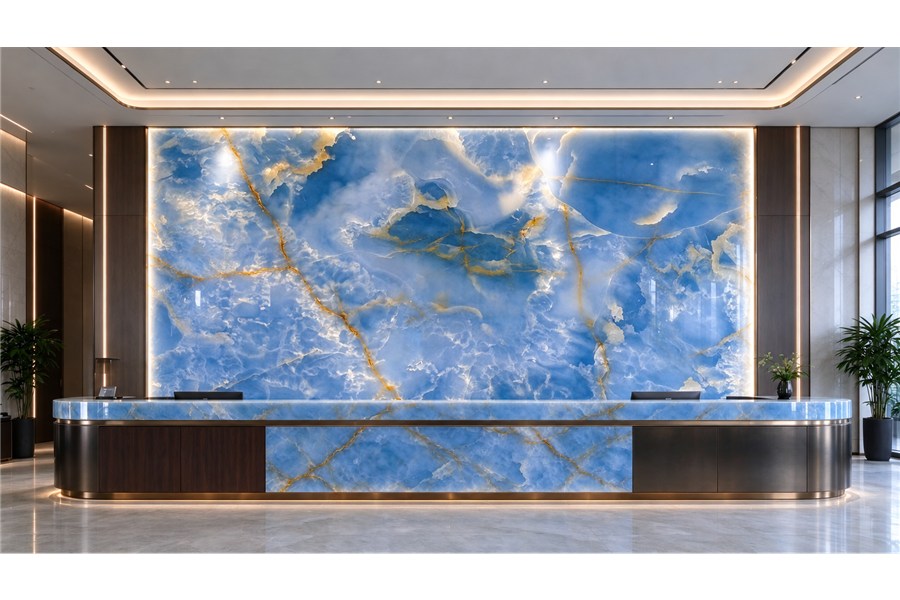
Backlit Feature Walls: One of the strongest applications for Blue Onyx. Large translucent panels combined with a properly designed LED lighting system can reveal the internal crystalline structure and transform the stone into an illuminated architectural feature.
Hotel Lobbies & Reception Areas: Blue Onyx works particularly well for reception backdrops, lobby feature walls and statement counters where the material can be viewed from a distance and become part of the overall interior identity.
Luxury Bars & Entertainment Areas: Backlit bar fronts, decorative wall panels and selected counter surfaces can take advantage of the contrast between cool blue areas and warmer golden mineral movement.
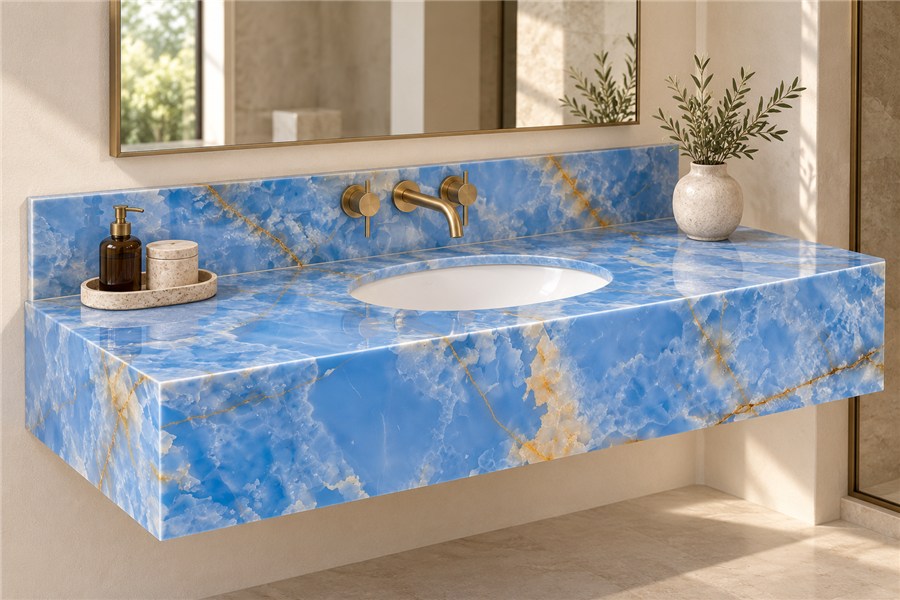
High-End Residential Interiors: Blue Onyx can be used for feature walls, bathroom accents, vanity areas and decorative panels where a distinctive natural material is preferred over conventional marble.
Commercial Display & Feature Surfaces: Luxury retail spaces, restaurants, private clubs and other design-led commercial interiors can use Blue Onyx as a focal material rather than applying it throughout the entire project.
Translucency & Backlighting
Translucency is one of the defining characteristics of Blue Onyx. Light can penetrate suitable areas of the stone and reveal internal crystalline structures, mineral boundaries and color transitions that may appear much more subtle when the slab is viewed without illumination.
However, translucency is not perfectly uniform across every slab. Milky white crystalline areas, dense golden mineral zones and variations in stone thickness can transmit different amounts of light. For this reason, a backlit Blue Onyx installation should be designed around the actual selected slabs rather than assuming completely uniform illumination.
For premium backlit projects, FAVAN STONE recommends evaluating the slabs both under normal lighting and with transmitted light before fabrication. This allows the designer and project team to review:
- overall light transmission;
- distribution of blue and white translucent areas;
- density of golden or amber mineral zones;
- visible natural lines and internal structures;
- panel layout and visual continuity;
- the relationship between stone thickness and the proposed lighting system.
For large illuminated walls, slab sequence and cutting layout should ideally be planned together so that the strongest blue, white and golden areas are positioned intentionally within the final composition.
Installation & Maintenance
Blue Onyx requires more careful fabrication, installation and maintenance than harder natural stones such as granite or quartzite. Because architectural onyx is generally calcite-rich and relatively soft, fabrication should be carried out by experienced natural-stone professionals using appropriate cutting, reinforcement and installation methods.
A suitable penetrating sealer may be recommended depending on the application and selected material. For routine cleaning, use a soft cloth and a pH-neutral stone cleaner. Acidic cleaners, vinegar, lemon-based products and abrasive cleaning materials should be avoided because they may etch or damage the polished surface.
For backlit wall panels and other large-format installations, the stone, supporting structure, adhesive system and lighting design should be considered together. Panel thickness, reinforcement and fixing methods should be determined according to the final panel dimensions and project conditions.
Natural Variation & Slab Selection Guidance
Natural variation is a defining characteristic of Blue Onyx and should be considered during material selection. Even slabs cut from the same general stone category can show noticeable differences in blue intensity, white crystalline areas, golden mineral distribution, translucency and overall pattern movement.
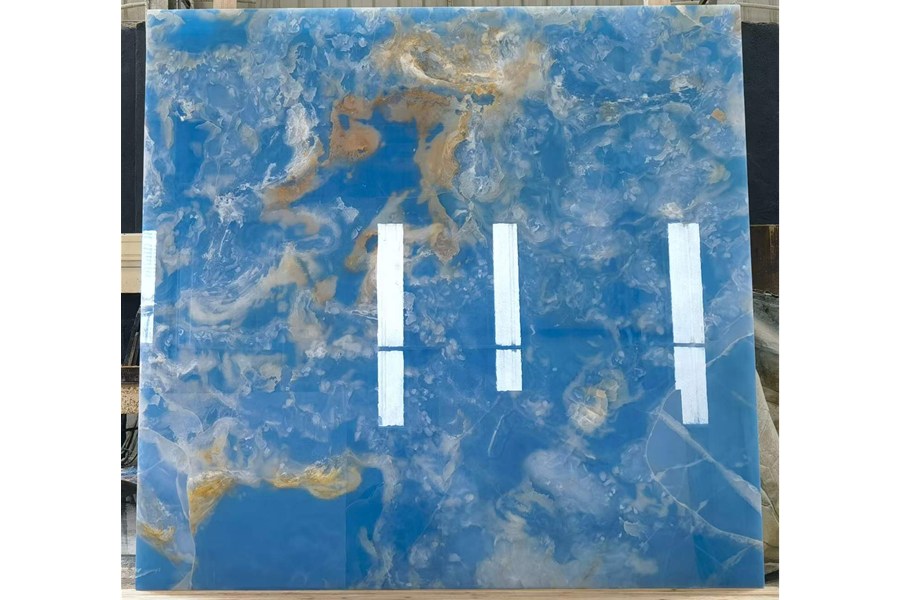
Some Blue Onyx slabs may be dominated by soft sky-blue and milky white crystalline formations, creating a lighter and more ethereal appearance. Other slabs can contain stronger golden, amber or rust-toned mineral areas that produce a warmer and more dramatic composition.
For this reason, small samples are useful for reviewing the general color family and surface finish, but they cannot fully represent the appearance of an entire slab or production lot.
For feature walls, backlit panels and multi-slab installations, FAVAN STONE recommends selecting from current full-slab photos or videos before fabrication. Important selection points include:
- overall blue color and saturation;
- distribution of milky white crystalline areas;
- amount and position of golden or amber mineral movement;
- translucency under transmitted light;
- natural lines, fissures and mineral boundaries;
- slab sequence and possible pattern continuity;
- final panel dimensions and cutting layout.
For large projects, slab selection and cutting planning should ideally be coordinated together. This helps position the most visually expressive areas of the stone where they will have the greatest impact in the finished installation.
Frequently Asked Questions About Blue Onyx
1. What is Blue Onyx?
Blue Onyx is a translucent natural decorative stone used for luxury interior architecture. Architectural Blue Onyx typically features soft blue, icy-blue and pale aqua colors combined with milky white crystalline formations and occasional golden, amber or rust-toned mineral movement.
2. Is Blue Onyx a natural stone?
Yes. Natural Blue Onyx is quarried and cut into slabs or panels for architectural applications. Its colors, crystalline structures and translucency are naturally variable, so every slab has an individual appearance.
3. Is Blue Onyx the same as Blue Onyx Marble?
Blue Onyx Marble is a commercial search term commonly used for architectural onyx. Despite the word “marble,” Blue Onyx is generally traded as a distinct decorative onyx category and should be evaluated according to the properties of the specific material rather than conventional marble specifications.
4. What colors are found in Blue Onyx?
Typical colors include sky blue, icy blue, pale aqua and milky white, often combined with golden yellow, honey, amber, beige or rust-toned mineral accents. The proportion and intensity of these colors vary naturally between slabs.
5. Is Blue Onyx translucent?
Yes. Translucency is one of the most distinctive characteristics of Blue Onyx. Suitable slab areas can transmit light and reveal internal crystalline patterns that are less visible under normal front lighting.
6. Can Blue Onyx be backlit?
Yes. Backlit Blue Onyx is widely used for statement walls, reception counters, bars and decorative panels. Because light transmission varies across each natural slab, the actual material should be evaluated with transmitted light before fabrication whenever possible.
7. What is the best application for Blue Onyx slabs?
Blue Onyx slabs are especially suitable for decorative feature walls, backlit panels, hotel lobbies, reception areas, luxury bars, vanity features and other interior applications where color and translucency are central to the design.
8. Can Blue Onyx be used for countertops?
Blue Onyx can be used for selected decorative countertops, vanity tops and statement counters, but it requires more care than granite or quartzite. Because calcite-rich onyx is relatively soft and sensitive to acids, it is better suited to controlled-use surfaces than heavily used kitchen worktops.
9. Is Blue Onyx suitable for kitchen countertops?
It is technically possible in selected situations, but Blue Onyx is generally not our first recommendation for a heavily used kitchen countertop. Quartzite or granite normally provides better resistance to scratching, wear and acidic food exposure. Blue Onyx is more valuable where its decorative and translucent qualities can be highlighted.
10. Can Blue Onyx be used for wall panels?
Yes. Blue Onyx wall panels are one of the material’s strongest applications. Large panels allow the natural blue, white and golden patterns to remain visible and can also be combined with backlighting for a more dramatic architectural effect.
11. Are Blue Onyx tiles available?
Blue Onyx tiles and cut-to-size pieces can be produced from suitable slabs according to project dimensions. Because the material has strong natural variation, tile layouts should be planned carefully when color or pattern consistency is important.
12. Can Blue Onyx be used in bathrooms?
Yes. It can be used for bathroom feature walls, vanity areas and selected decorative surfaces. Appropriate sealing, installation and maintenance are recommended, and acidic or abrasive cleaning products should be avoided.
13. How durable is Blue Onyx?
Blue Onyx is softer and more delicate than granite and quartzite. It performs best in decorative interior applications where heavy abrasion and impact are limited. Proper fabrication, installation and ongoing stone care are important for long-term performance.
14. Does Blue Onyx need sealing?
Sealing may be recommended depending on the stone, finish and intended application. The appropriate sealing system should be selected for the actual slab and installation conditions rather than applying a universal treatment to every project.
15. Why do Blue Onyx slabs look different from each other?
Blue Onyx is a natural material formed through variable mineral deposition. As a result, blue saturation, white crystalline structures, golden areas, veining and translucency can change considerably between blocks and individual slabs.
16. How should Blue Onyx slabs be selected for a backlit project?
For backlit projects, slabs should ideally be reviewed both under normal lighting and with transmitted light. The project team should consider light transmission, mineral density, color distribution, slab sequence, panel dimensions and the intended final lighting effect before cutting.
17. What affects the price of Blue Onyx?
Blue Onyx price can vary according to slab size and thickness, blue color quality, translucency, pattern character, usable area, natural structure, surface finish, available quantity and fabrication requirements. Backlit or large-format projects may also require additional selection and processing considerations.
18. How do I select Blue Onyx for a large luxury project?
For projects requiring multiple Blue Onyx slabs, selection should be based on the complete required quantity rather than one reference slab. Full-slab review, transmitted-light inspection where relevant, slab sequencing and cutting-plan coordination help achieve a more controlled final appearance.
Current Blue Onyx Slab Selection
Current Blue Onyx slabs can vary from soft sky-blue and milky-white selections to more expressive slabs containing stronger golden, amber and rust-toned mineral movement. Translucency and internal crystalline patterns also vary naturally from slab to slab.
For material selection, FAVAN STONE can provide current slab photos, videos, dimensions and available quantities. For backlit projects, suitable slabs can also be evaluated according to their transmitted-light appearance before final cutting and production planning.
Expert Commentary & Analysis
From our material-selection perspective, Blue Onyx should not be evaluated in the same way as an ordinary blue natural stone. Its real design value comes from the interaction between blue color, crystalline structure, warm mineral accents and translucency.
For a conventional installation, the priority may be the visible slab color and pattern. For a backlit installation, however, the internal structure becomes equally important. Areas that appear relatively quiet under normal lighting can become much more expressive when illuminated, while dense golden or milky mineral zones may transmit light differently from clearer blue areas.
For this reason, we recommend selecting Blue Onyx according to the final design intent rather than choosing slabs only by color.
Project & Material Selection Notes
For hotel lobbies, luxury residences, bars, reception areas and other statement interiors, Blue Onyx slab selection can be coordinated with the architectural elevation and cutting plan. This allows major blue, white and golden mineral areas to be positioned intentionally within the finished composition.
For large-format or backlit installations, we recommend confirming the selected slabs, panel dimensions, reinforcement requirements, cutting layout and lighting concept before production. Where several slabs are used together, slab sequence and pattern relationships should also be reviewed to achieve the intended overall visual effect.