What Is Shangri La Granite?
Shangri La Granite is an exotic natural stone quarried in Brazil and commercially traded internationally as granite. It is also known as Shangri-La Granite, Shangrila Granite, Shangrilla Granite and Shangri-La Golden Brown Granite.
Petrographically, some geological references describe Shangri La as a migmatite rather than a conventional homogeneous granite. This complex geological formation helps explain its unusually dynamic appearance, with contrasting mineral zones, folded structures and dramatic changes in color across a single slab.
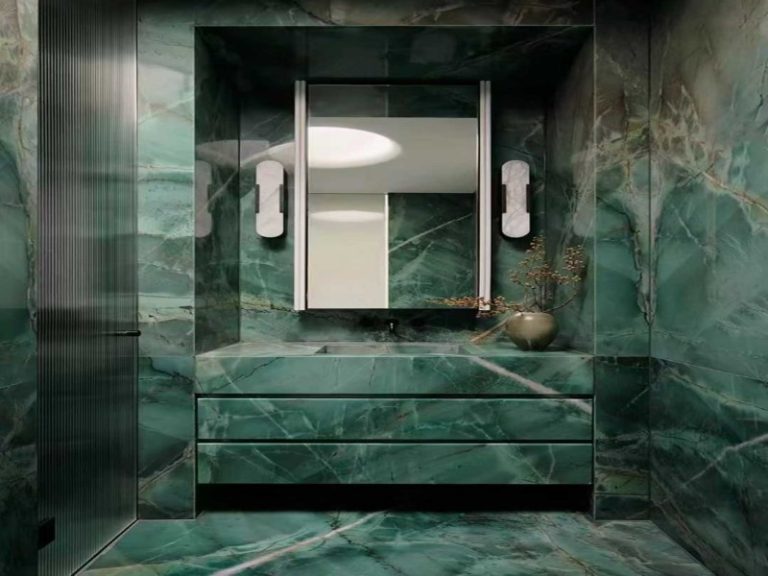
The overall palette can include silver grey, smoky grey, grey-green, sage green, cream, beige, copper, rust brown, golden brown and dark mineral areas. Some slabs are dominated by warmer copper and rust coloration, while others appear considerably cooler with stronger silver-grey and green-grey movement.
This makes Shangri La Granite particularly attractive for projects where natural stone is intended to function as a visual feature rather than as a uniform background surface.
Material Specifications & Available Options
| Property | Specification / Description |
|---|---|
| Commercial Material | Natural Granite / Exotic Brazilian Granite |
| Petrographic Classification | Migmatite according to published geological references |
| Origin | Brazil — Minas Gerais |
| Primary Colors | Silver Grey, Grey Green, Sage Green, Beige, Copper, Rust Brown, Golden Brown, Dark Brown and Black |
| Pattern & Movement | Abstract geological movement, folded mineral structures, irregular brecciated formations and broad landscape-like patterns |
| Natural Variation | Very High — color balance, mineral distribution, pattern intensity and movement can change substantially between blocks and individual slabs |
| Bulk Density | Approx. 2.65 t/m³ — published reference value |
| Water Absorption | Approx. 0.05 wt.% — published reference value |
| Compressive Strength | Approx. 187.5 MPa — published reference value |
| Flexural / Bending Strength | Approx. 14.2 MPa — published reference value |
| Wear Resistance | Good resistance expected for this hard natural stone category; application-specific testing should be confirmed where required by project specifications |
| Common Finishes | Polished, Honed, Leathered and Sawn; additional finishes can be evaluated according to project requirements |
| Typical Slab Thickness | 18mm / 20mm / 30mm, subject to current slab and block availability |
| Available Formats | Full Slabs, Cut-to-Size Panels, Countertops, Kitchen Islands, Wall Panels, Flooring, Vanity Tops and Custom Fabrication |
| Technical Data Note | Physical-property values above are published reference values for Shangri-La / corresponding commercial material and should not replace current laboratory testing where certified project data is required |
| Slab Selection | Full-slab selection is strongly recommended because of the exceptionally high natural variation |
Recommended Applications & Design Solutions
At FAVAN STONE, we consider Shangri La Granite a slab-driven material. Its value lies in the composition of each individual slab, so the intended application should be considered together with the actual available material before fabrication.
Statement Kitchen Islands & Countertops
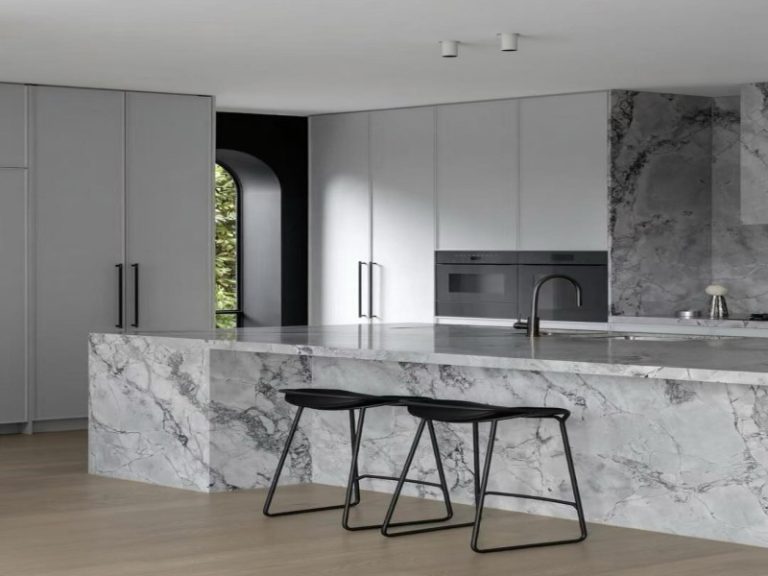
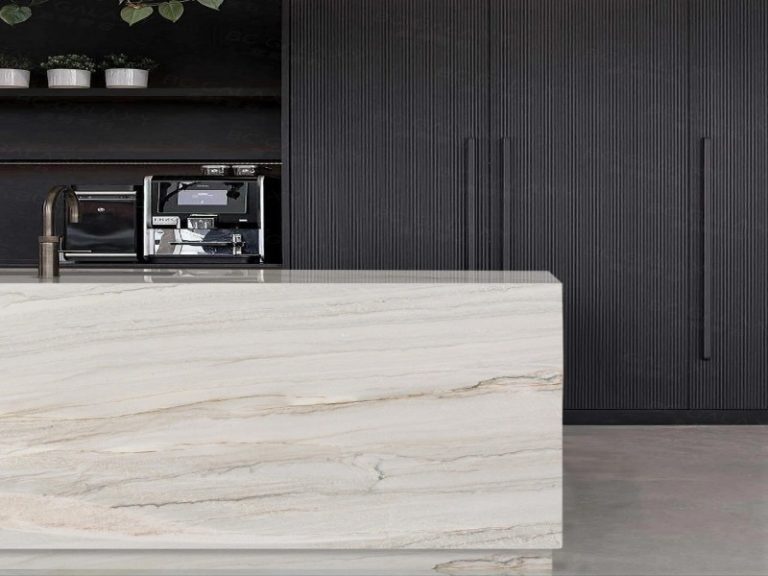
Large kitchen islands are one of the strongest applications for Shangri La Granite. The broad surface allows the copper, rust, grey-green and dark mineral formations to remain visible as one continuous natural composition.
For island projects, we recommend reviewing the countertop dimensions directly against the selected slab before cutting. This allows important geological features to be positioned on the main visible surface while sink, cooktop and other cut-outs can be coordinated with less visually important areas where possible.
Feature Walls & Large-Format Panels
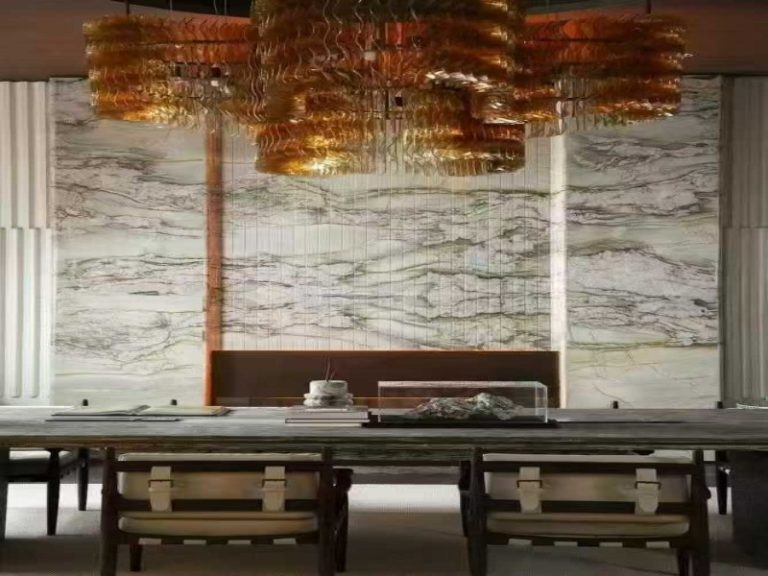
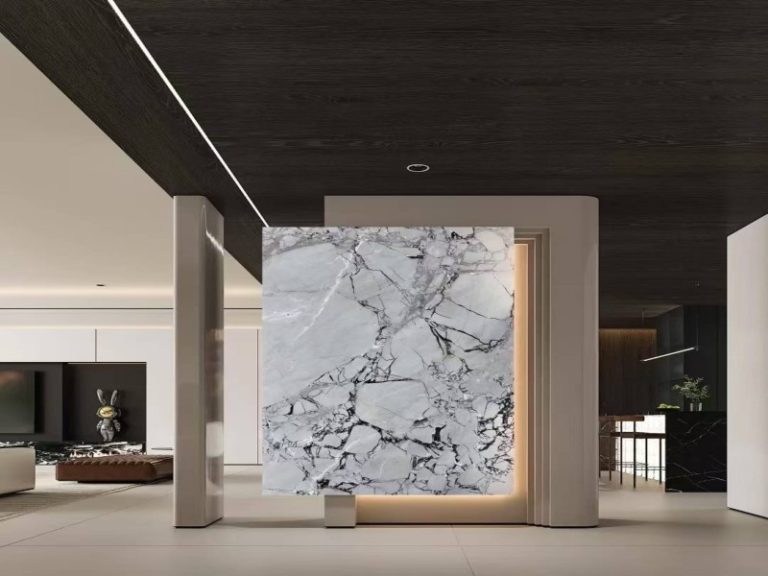
The abstract movement of Shangri La Granite makes it particularly effective for feature walls, hotel reception areas, luxury residential backgrounds, fireplace walls and commercial statement surfaces.
Slabs with strong copper and rust formations create a warmer and more expressive appearance, while selections dominated by silver-grey and grey-green areas produce a cooler and more architectural character.
Hotel, Retail & Commercial Interiors
For hospitality and commercial projects, Shangri La Granite can be used for reception desks, wall panels, bar counters, display surfaces and other high-visibility architectural elements where a distinctive natural material is required.
Flooring & Architectural Surfaces
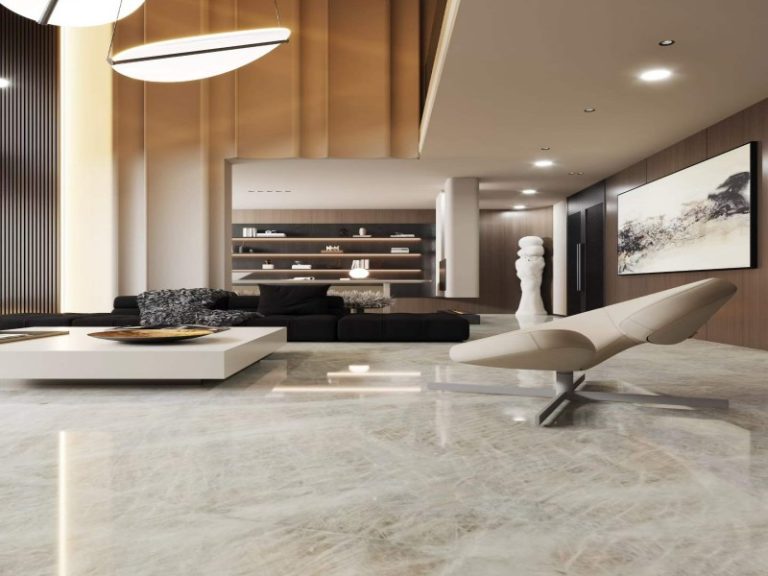
As a hard natural stone, Shangri La Granite can also be considered for flooring and other architectural surfaces. For large commercial flooring areas, the strong natural variation should be evaluated carefully because the finished appearance will be considerably more dynamic than that of a uniform granite.
Custom Stone Fabrication
Selected slab areas can be fabricated into vanity tops, tables, furniture surfaces, fireplace surrounds and bespoke stone elements. For custom fabrication, the cutting position should be planned according to both the visual composition and the natural geological structure of the slab.
Installation & Maintenance
Professional fabrication and installation are recommended, particularly for oversized panels, islands and multi-slab layouts. Sealing requirements should be evaluated according to the selected slab, finish and application. For routine care, use pH-neutral natural-stone cleaners and avoid strongly acidic or abrasive cleaning products.
Natural Variation & Slab Selection Guidance
Shangri La Granite has very high natural variation, and this should be treated as a fundamental characteristic of the material rather than a defect.
A single production can contain substantial changes in background tone and mineral distribution. One slab may feature dominant copper, rust and golden-brown areas, while another may be primarily silver grey and grey-green with only limited warm coloration.
The geological pattern can change just as dramatically. Some slabs contain large flowing formations, while others show fragmented, brecciated structures or broad areas of relatively quiet background.
For this reason, a small sample cannot accurately represent the overall appearance of Shangri La Granite. For design-sensitive applications, actual full-slab photos or videos should be reviewed before material confirmation.
Selection for a Single Statement Island
For a large kitchen island, we recommend selecting the slab according to its complete composition rather than focusing on one attractive detail. The finished island dimensions can be positioned digitally or manually over the slab image to determine which geological areas will remain visible after fabrication.
Selection for Feature Walls
For feature walls using several slabs, color transition becomes particularly important. A slab with strong copper and rust coloration placed directly beside a predominantly silver-grey slab can create a dramatic change in appearance.
Depending on the design intention, slabs can either be selected for closer visual compatibility or deliberately arranged to emphasize the natural variation.
Multi-Slab Matching & Project Selection
For larger residential, hospitality or commercial projects, FAVAN STONE recommends selecting slabs from the same block or closely related production whenever possible.
Before fabrication, the available slabs can be arranged in sequence and reviewed together. This allows the project team to evaluate background color, major geological formations, vein direction and transitions between adjacent panels.
For projects where appearance is particularly important, slab numbering and dry-layout planning can be completed before cutting to reduce unexpected visual changes during installation.
Frequently Asked Questions About Shangri La Granite
1. What is Shangri La Granite?
Shangri La Granite is an exotic Brazilian natural stone known for dramatic silver-grey, grey-green, copper, rust and golden-brown geological movement. It is commercially traded as granite and is also described petrographically as a migmatite in geological references.
2. Where does Shangri La Granite come from?
Shangri La Granite originates from Brazil, with published stone references associating the material with Minas Gerais.
3. What other names are used for Shangri La Granite?
Common commercial naming variations include Shangri-La Granite, Shangrila Granite, Shangrilla Granite and Shangri-La Golden Brown Granite.
4. Is Shangri La Granite actually granite?
The stone is internationally marketed and fabricated as a granite-category natural stone. Petrographic references may classify the material more specifically as migmatite because of its complex geological formation.
5. What colors are found in Shangri La Granite?
Typical slabs can contain silver grey, smoky grey, grey-green, sage green, cream, beige, copper, rust brown, golden brown and dark mineral areas. The balance between these colors varies considerably.
6. Does every Shangri La Granite slab look the same?
No. Shangri La Granite has very high natural variation. Different slabs can vary substantially in color balance, geological movement and the proportion of warm and cool mineral areas.
7. Why do some Shangri La Granite slabs look greener while others look more brown?
The difference comes from natural mineral distribution within the stone formation. Some blocks contain stronger grey-green and sage areas, while others contain more copper, rust and golden-brown movement.
8. Is Shangri La Granite suitable for kitchen countertops?
Yes. It can be used for kitchen countertops and is particularly effective when the project allows a large section of the natural slab pattern to remain visible.
9. Is Shangri La Granite suitable for a kitchen island?
Yes. Large islands are one of the most visually effective applications because the broad surface can display the stone’s abstract geological movement. Actual slab selection and cutting layout are recommended before fabrication.
10. Can Shangri La Granite be used for feature walls?
Yes. Its dramatic multicolor movement makes it particularly suitable for luxury residential feature walls, hotel reception areas, fireplace walls and other statement architectural surfaces.
11. Can Shangri La Granite be used for flooring?
Yes, it can be considered for flooring. For large areas, however, buyers should understand that its strong natural variation will create a much more dynamic finished appearance than a conventional uniform granite.
12. Can Shangri La Granite be used outdoors?
It may be considered for exterior applications depending on the project conditions. Exterior use should be evaluated according to climate, finish, thickness, installation system and the technical requirements of the specific project.
13. What finish is best for Shangri La Granite?
Polished finishing generally provides the strongest color depth and contrast, emphasizing copper, rust and grey-green mineral areas. Honed or leathered finishes can create a softer appearance. Finish selection should depend on both design intent and application.
14. Does Shangri La Granite need sealing?
Sealing requirements depend on the selected slab, surface finish and application. For countertops and frequently used architectural surfaces, sealing should be evaluated during fabrication and installation.
15. What slab thicknesses are available?
Common slab thicknesses include approximately 18mm, 20mm and 30mm, depending on current block production and slab inventory. Custom project requirements can be evaluated according to available material.
16. Can Shangri La Granite be bookmatched?
Certain sequential slabs may create dramatic mirrored or coordinated layouts, but the result depends heavily on the actual block and cutting sequence. Bookmatching should therefore be evaluated using current slab photos rather than assumed from the material name.
17. How should Shangri La Granite be selected for a large project?
For multi-slab projects, we recommend reviewing the actual slabs together and considering background tone, warm-to-cool color balance, major geological structures and panel sequence. Selecting slabs from the same block or related production can help achieve better overall coordination.
18. What information should I provide when requesting Shangri La Granite?
Please provide the intended application, approximate quantity, finished dimensions, thickness, surface finish and any preferred color direction. For architectural projects, drawings or panel layouts can help us evaluate slab quantities, cutting positions and suitable material groups more accurately.
Current Shangri La Granite Slab Selection
Because Shangri La Granite varies substantially between blocks and slabs, current inventory should be reviewed individually. Available slabs may range from warmer selections dominated by copper, rust and golden-brown movement to cooler slabs with stronger silver-grey, sage and grey-green coloration.
FAVAN STONE can provide current full-slab photos, videos, dimensions and available quantities for selection. For projects requiring multiple slabs, we can also review the available production as a group and recommend combinations according to the required overall appearance.
Expert Commentary & Analysis
The defining value of Shangri La Granite is its geological composition rather than a single background color. The strongest slabs can combine cool grey-green mineral areas with warm copper and rust formations in the same surface, producing an appearance closer to a natural abstract landscape than a conventional granite pattern.
From a material-selection perspective, there is therefore no single “standard” Shangri La Granite appearance. A warm copper-rich slab and a predominantly silver-grey slab may both belong to the same commercial stone category while creating completely different design effects.
For statement applications, we recommend selecting the individual slab according to the intended visual effect. For larger projects, however, the relationship between multiple slabs becomes more important than the beauty of any single slab.
Project & Material Selection Notes
For kitchen islands, feature walls and other design-sensitive applications, final slab selection should ideally be completed before fabrication. Project drawings can be reviewed together with available slab dimensions to determine cutting orientation, visible areas and material utilization.
For multi-slab installations, slab numbering and layout planning are recommended before cutting. This is particularly important for Shangri La Granite because abrupt changes between copper-rich, grey-green and silver-grey areas can significantly affect the final installed appearance.
Published physical-property values can be useful for preliminary material evaluation, but where certified density, water absorption, compressive strength, bending strength or other engineering properties are required, testing corresponding to the actual selected material or production batch should be used for final project specification.